
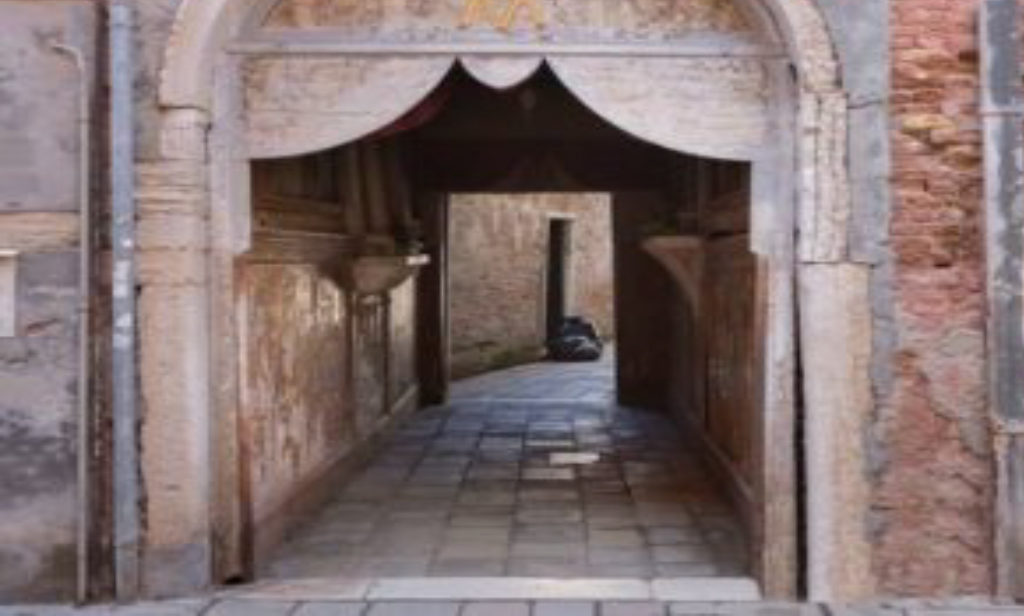
If walking around Venice you don’t want to risk misfortune, you have to keep in mind that there are some stones, inserted between the trachyte stones paving squares and streets of the city, which should not be absolutely trampled.
According to legend, one of these stones even stopped one of the many plagues that assaulted the Venetian Republic in the past centuries. In particular, the reference would be to the plague of 1630, which fell just over that red colored stone, thus failing to cross the border of the Sotoportego of Corte Nova. In that area of the Sestiere di Castello they did not register infected or dead. The inhabitants of the Nova Court were all free from the plague.
A red stone, then. A stone of a color that at that time symbolized mourning, set precisely to remember how the same plague, the bearer of death, was paralyzed before the sacred image of the Virgin that was placed in the sotoportego. A few steps from the church of San Lorenzo where, even before that time, a sort of open-air chapel dedicated to the Virgin had been built and which already in previous plagues proved to be a divine saving presence.
A Venetian corner not widely known to the hit-and-run tourism, built as a casket for a unique ex popular vote. The wooden coffered ceiling once showed itself to be much more opulent than gold and silver decorations, to serve as a precious heavenly vault to the effigy of the Madonna. At that point, marked by red stone, he stopped the plague. From here, perhaps also because of a sign of respect for the faith, the warning not to trample on it, on pain of suffering misfortunes that can happen to those who do not care for the good of others. And in our day, God knows how many red stones Venice would need.
Location: Sotoportego de la Corte Nova, Venice