
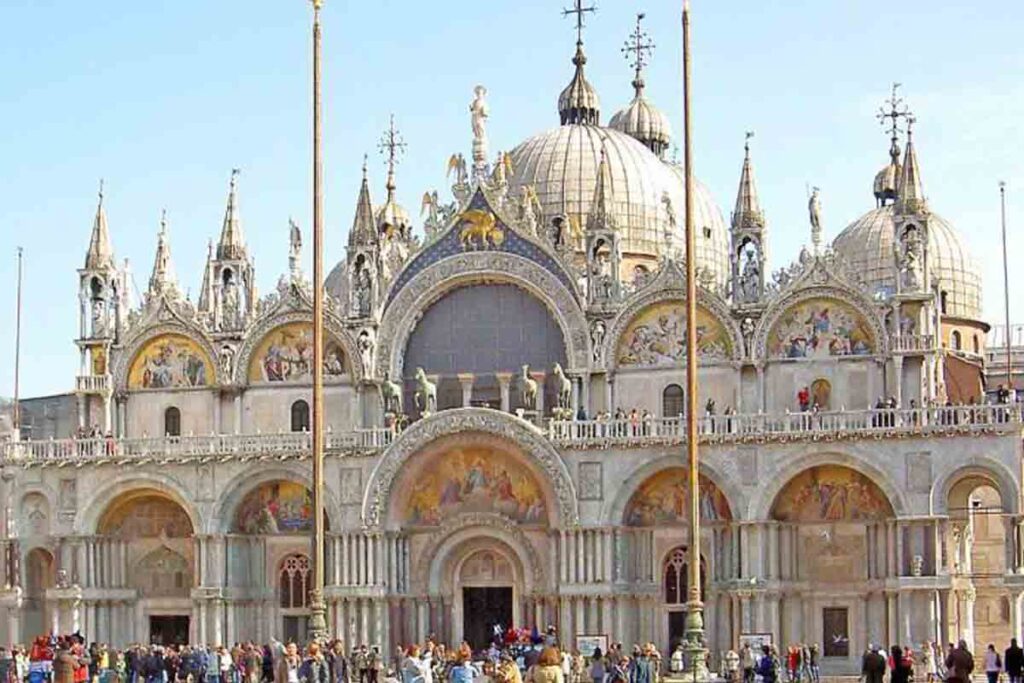
The patron saint of Venice Saint Mark is celebrated on April 25, which is traditionally considered the date of his death. Buried in Alexandria/Egypt in 68 AD, his remains remained in the same place for more than seven centuries.
The ancient legend says that Mark, after having evangelized northern Italy, during his return to Alexandria, stopped in Venice. At night an angel, represented by a winged lion, appeared to him in a dream and greeted him with the words: “Pax tibi Marce, evangelista meus. Hic requiescet corpus tuum” (Peace to you, Mark, my evangelist. Here will rest your body).
The winged lion announced that Mark would find rest and veneration in Venice. With the passage of time, the Venetians felt increasingly obliged to return St. Mark to Venice. In the year 828 the relics, stolen in Alexandria by two Venetian merchants, were received in Venice by the Doge who justified the undertaking. The remains were temporarily placed in the Doge’s Palace, but when the Basilica of San Marco was built, they were transferred there, where they are still today.
The four mosaics in the lunettes of the facade of the basilica illustrate the important vicissitudes of the body of St. Mark between Alexandria/Egypt and Venice.
The possession of St. Mark’s relics had a strong impact on the Venetians who, feeling safe and protected, developed a strong devotion.
St. Mark represented as a winged lion became the symbol of the lagoon city and has always been considered a symbol of power and royalty.
Location: Basilica San Marco, Venice